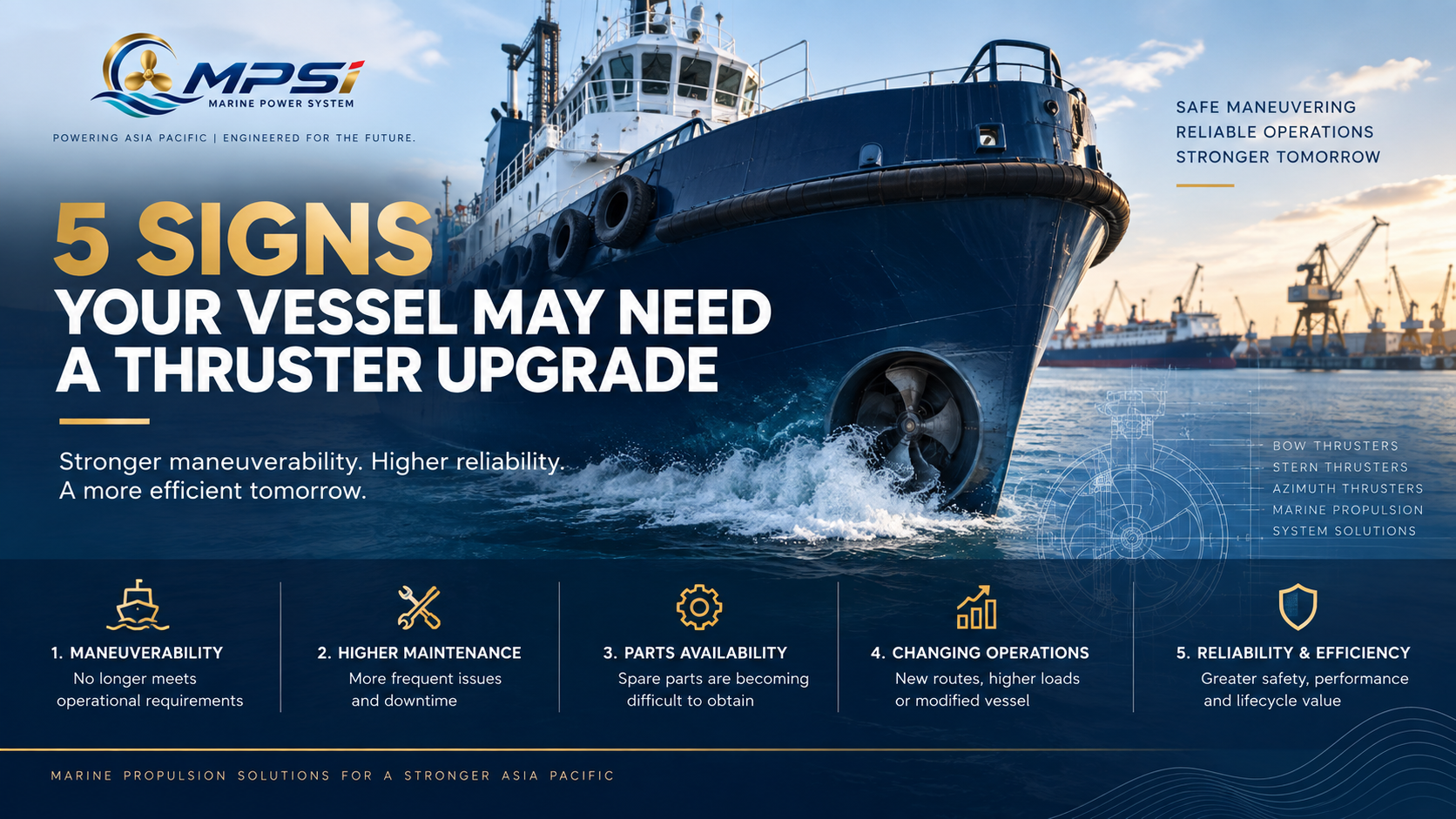
5 Signs Your Vessel May Need a Thruster Upgrade
Marine thrusters play an important role in vessel maneuverability, particularly during berthing, docking, low-speed operations, and operations in confined waters.
However, a thruster system that was suitable when a vessel was originally built may no longer be optimal years later. Changes in operating profile, equipment condition, maintenance requirements, or vessel modifications can all affect propulsion and maneuvering performance.
Here are five signs that vessel owners and operators should consider when evaluating whether a thruster upgrade may be necessary.
1. Maneuverability Is No Longer Meeting Operational Requirements
One of the clearest indicators is reduced maneuvering performance.
If the vessel increasingly requires assistance during berthing, struggles against wind or current, or requires more time to maneuver safely in confined areas, the existing thruster may no longer provide sufficient thrust for the vessel's current operating conditions.
This does not necessarily mean the thruster itself has failed. Vessel displacement, operating area, windage, draft, and changes to the vessel can also affect the required thrust.
2. Maintenance and Downtime Are Increasing
Older thruster systems may require increasingly frequent maintenance.
Repeated problems involving seals, bearings, hydraulic systems, gears, electric motors, controls, or other components can gradually increase the vessel's maintenance cost and downtime.
At a certain point, continuously repairing an aging system may become less economical than evaluating refurbishment or replacement.
The decision should therefore consider not only equipment cost, but also downtime, spare parts availability, service support, and the operational consequences of unexpected failure.
3. Spare Parts Are Becoming Difficult to Obtain
Marine equipment can remain in operation for decades, while individual components may become obsolete much earlier.
When critical spare parts become difficult to source, lead times increase, or original manufacturers discontinue support for older models, maintaining the existing thruster can create additional operational risk.
A planned upgrade allows vessel owners to manage this transition before equipment availability becomes an emergency issue.
4. The Vessel's Operating Profile Has Changed
A vessel may operate very differently today compared with when it was originally designed.
It may enter different ports, operate in stronger currents, perform more frequent maneuvering, carry additional equipment, or have undergone modifications that changed displacement or windage.
In these situations, the original thruster specification should not automatically be assumed to remain optimal.
A new assessment of the vessel's operating conditions can determine whether the existing bow thruster, stern thruster, or azimuth thruster configuration still provides appropriate performance.
5. Reliability and Efficiency Have Become More Important
Modern vessel operations increasingly emphasize reliability, operational efficiency, safety, and lifecycle cost.
Newer thruster systems may offer improved control, integration, monitoring, and system efficiency compared with older installations.
For some vessels, an upgrade can also be considered together with broader modernization projects involving electrical systems, propulsion controls, power management, or hybrid and electric propulsion.
Upgrade, Retrofit, or Maintain?
Not every performance issue requires complete replacement.
Depending on the vessel and equipment condition, the appropriate solution may involve maintenance, overhaul, component replacement, control-system modernization, retrofit, or installation of a new thruster system.
The correct decision should be based on technical assessment rather than equipment age alone.
Key factors include vessel type, displacement, operating profile, required thrust, available electrical or hydraulic power, installation space, duty cycle, classification requirements, and lifecycle cost.
Planning a Thruster Upgrade
For shipowners, shipyards, naval architects, and marine engineering companies considering a thruster upgrade or new propulsion project, early technical evaluation can help identify the most suitable configuration before equipment selection.
MPSI supports marine propulsion projects across Asia Pacific, including bow thrusters, stern thrusters, azimuth thrusters, and related marine power system solutions.
Planning a newbuild, retrofit, or thruster replacement project? Contact MPSI to discuss your vessel requirements with our marine propulsion team.