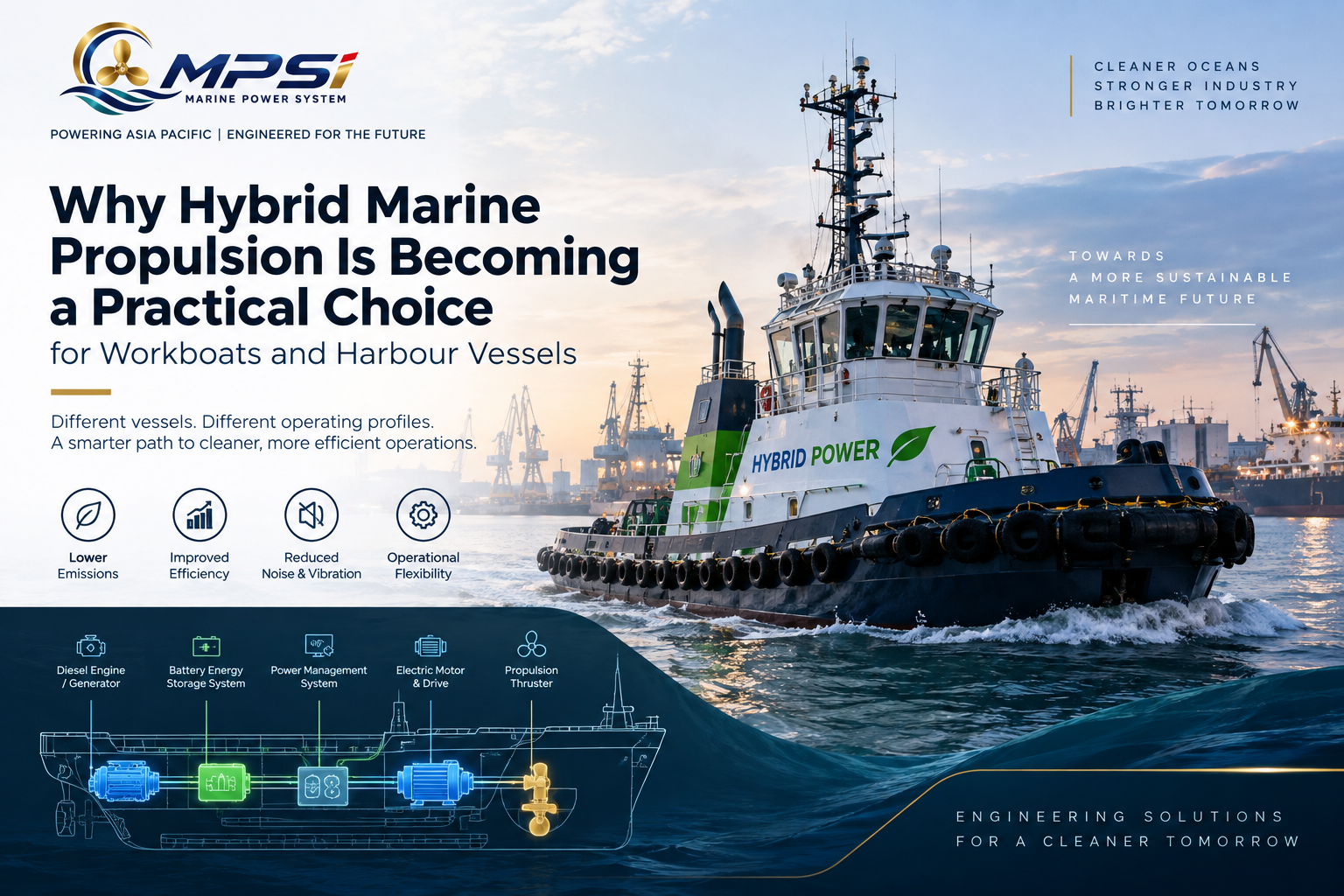
The maritime industry's transition toward lower-emission propulsion does not necessarily mean every vessel needs to become fully electric.
For many workboats, tugboats, harbour craft and other commercial vessels, hybrid propulsion can provide a practical bridge between conventional diesel propulsion and fully electric operation.
The key, however, is not simply adding batteries to a vessel.
A successful hybrid propulsion system starts with understanding how the vessel actually operates.
Different Vessels, Different Operating Profiles
Commercial vessels rarely operate continuously at their maximum propulsion power.
A harbour tug, for example, may experience very different operating conditions throughout a typical working cycle: transit, standby, low-speed manoeuvring, assisting vessels and short periods of high bollard-pull demand.
Similarly, ferries and harbour craft may operate on predictable routes with frequent departures, arrivals and periods alongside the berth.
These varying load profiles create opportunities for hybrid propulsion systems to operate engines, generators, batteries and electric propulsion equipment more efficiently.
This is why propulsion selection should begin with the vessel's operational profile, rather than simply selecting equipment based on maximum installed power.
What Does a Hybrid Marine Propulsion System Look Like?
There is no single hybrid architecture suitable for every vessel.
Depending on vessel requirements, a system may combine:
Diesel engines or generator sets
Providing primary power and supporting longer-duration operations.
Battery Energy Storage System (BESS)
Supporting peak loads, low-load operation and potentially zero-emission operation for certain periods.
Power Management System (PMS)
Coordinating power generation, energy storage and vessel demand.
Electric motors and drives
Converting electrical power into controlled propulsion power.
Propulsion thrusters
Delivering thrust and manoeuvrability according to the vessel's operational requirements.
The integration between these components is just as important as the individual equipment itself.
Why Hybrid Can Make Sense for Workboats
One potential advantage of hybrid propulsion is the ability to better match power generation with actual vessel demand.
Conventional engines operating for extended periods at low loads may not always operate at their most efficient point.
A properly designed hybrid system can allow batteries to support certain operating conditions while engines or generator sets operate closer to their intended operating range.
Depending on the vessel's duty cycle, this may provide several potential benefits:
- Reduced engine operating hours
- Improved fuel efficiency
- Lower local emissions
- Reduced noise and vibration during selected operations
- Better response to short-duration peak power demand
- Greater flexibility in future vessel energy strategies
However, these benefits should never be assumed automatically.
The economics and technical suitability of hybridisation depend heavily on the vessel's operating profile.
Full Electric or Hybrid?
Fully electric propulsion can be attractive for vessels operating predictable routes with relatively short sailing distances and reliable access to charging infrastructure.
For vessels requiring longer endurance, unpredictable operating schedules or extended offshore operation, full electrification can be considerably more challenging.
Hybrid propulsion therefore represents another option.
Instead of asking:
"Should this vessel be electric?"
A more useful engineering question may be:
"Which propulsion architecture best matches this vessel's actual operating profile?"
For some vessels, conventional diesel propulsion may remain appropriate.
For others, diesel-electric architecture may provide advantages.
And for vessels with suitable duty cycles, battery-assisted hybrid or fully electric propulsion may become increasingly attractive.
Thruster Selection Remains Critical
Changing the vessel's energy source does not remove the importance of propulsion efficiency.
Thruster configuration, propeller characteristics, motor selection, power electronics and vessel hydrodynamics all influence overall system performance.
Azimuth thrusters, for example, can combine propulsion and steering capability and are widely considered for vessels requiring strong manoeuvrability.
But selecting a thruster should not be treated as an isolated equipment decision.
The propulsion system needs to be evaluated together with vessel resistance, required thrust, operating speed, manoeuvring requirements, available electrical power and expected duty cycle.
Start With the Vessel, Not the Technology
As the maritime industry evaluates new propulsion technologies, there is a risk of focusing too heavily on individual technologies — batteries, motors, alternative fuels or specific propulsion equipment.
The better starting point is the vessel itself.
What does the vessel need to accomplish?
How many hours does it operate?
At what power levels?
How much time is spent manoeuvring, transiting, operating at high load or waiting?
What charging or shore-power infrastructure is available?
Once these questions are understood, shipowners, shipyards, naval architects and equipment suppliers can evaluate which propulsion architecture provides the best balance between performance, efficiency, reliability and lifecycle cost.
The Path Toward Smarter Marine Propulsion
The transition toward cleaner shipping will not follow one identical path for every vessel.
For many commercial vessels, the near-term opportunity may lie in developing smarter propulsion systems that combine proven marine engineering with increasingly flexible electrical technologies.
Hybrid propulsion is one of those possibilities.
But ultimately, the most effective propulsion system is not necessarily the newest technology.
It is the system that best matches the vessel's mission.
MPSI Asia works with shipyards, shipowners, naval architects and marine industry partners across Asia Pacific to support the evaluation and development of marine propulsion solutions, including azimuth thrusters, electric propulsion and integrated propulsion systems.
Marine Power System Indonesia (MPSI)
Powering Asia Pacific | Engineered for the Future