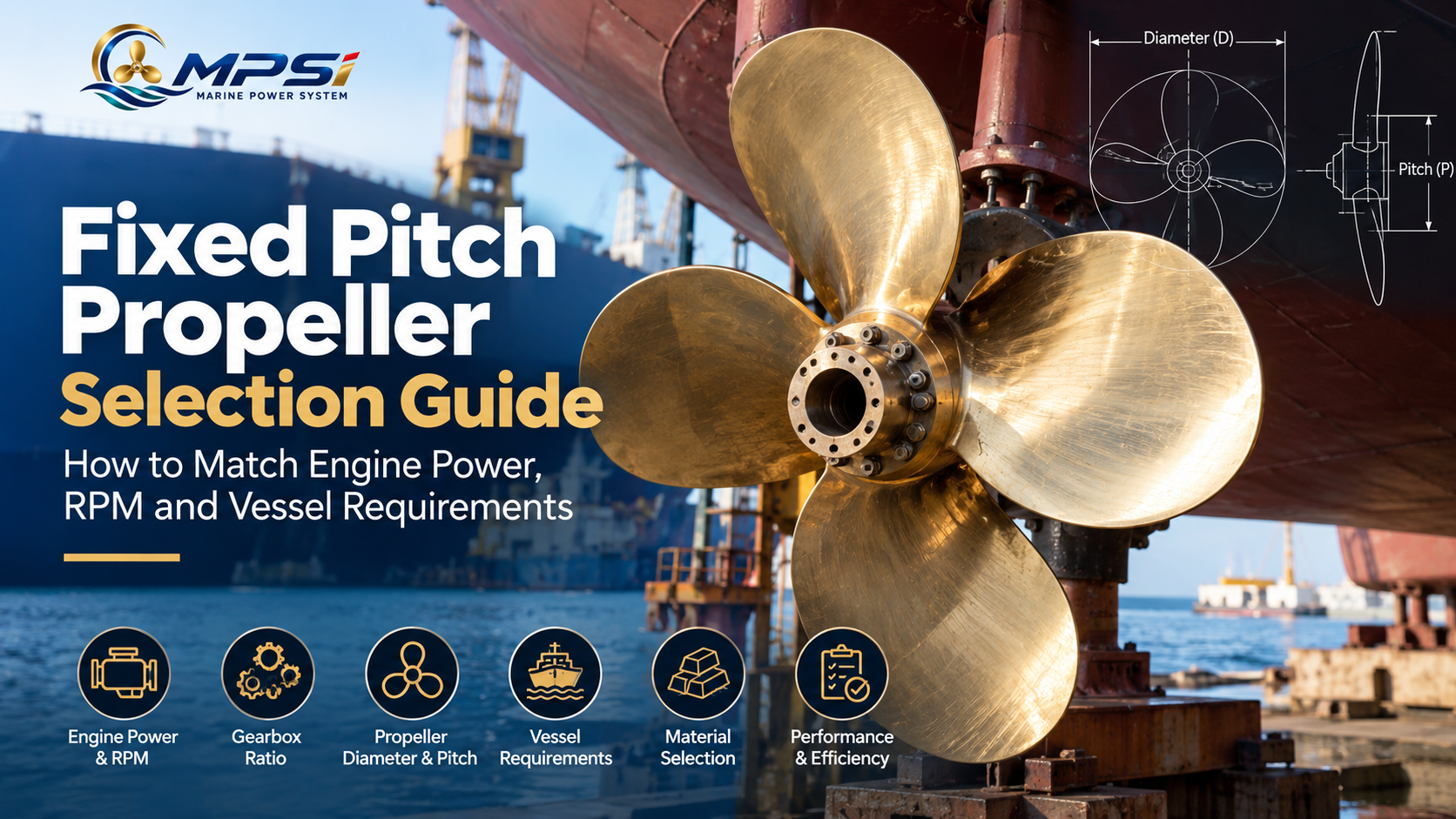
Fixed Pitch Propeller Selection Guide: How to Match Engine Power, RPM and Vessel Requirements
Introduction: Why Proper Propeller Selection Matters
A marine propulsion system is only as effective as the interaction between its engine, gearbox, propeller and vessel hull.
For shipowners, shipyards and marine engineers, selecting a fixed pitch propeller (FPP) is an important engineering decision that directly affects fuel efficiency, vessel speed, manoeuvrability, vibration and long-term operating costs.
One common misconception is that engine power alone determines the correct propeller size.
In reality, two vessels equipped with engines of identical power may require significantly different propeller configurations depending on their hull design, operating conditions, gearbox reduction ratio and intended service.
This guide explains the key technical considerations when selecting a fixed pitch propeller for commercial marine applications.
1. What Is a Fixed Pitch Propeller?
A fixed pitch propeller is a marine propeller with blades whose pitch is fixed during operation. Unlike a controllable pitch propeller (CPP), its blade pitch cannot be adjusted while the vessel is operating.
Fixed pitch propellers are widely used in commercial marine applications, including:
Tugboats and workboats
Cargo vessels and general-purpose ships
Fishing vessels
Passenger ferries
Landing craft and utility vessels
Inland and coastal vessels
Their relatively straightforward mechanical design makes them attractive for applications where reliability, maintainability and cost-effectiveness are important.
However, achieving good propulsion performance requires proper matching between the propeller, engine and vessel.
2. Why Engine Power Alone Is Not Enough
Consider a vessel equipped with a 100 kW marine diesel engine.
It may seem reasonable to request a fixed pitch propeller based only on the engine's rated power.
However, 100 kW alone does not establish the correct propeller diameter, pitch or blade configuration.
Several additional parameters are essential:
Engine rated power: The maximum or specified continuous power available under the applicable engine rating.
Engine rated RPM: The engine rotational speed at the relevant power rating.
Gearbox reduction ratio: Determines the relationship between engine RPM and propeller shaft RPM.
Vessel operating speed: Influences the propeller's required thrust and operating efficiency.
Hull characteristics: Vessel displacement, hull form and resistance affect propulsion demand.
Propeller installation clearance: The available space beneath the hull limits propeller diameter and influences vibration and cavitation performance.
Operating profile: A vessel operating continuously at low speed may require a different design from one intended for higher-speed transit.
A technically appropriate propeller must be selected using these parameters together rather than treating engine power as the sole design criterion.
3. Understanding Gearbox Ratio and Propeller Shaft RPM
The gearbox reduction ratio is one of the most important factors in marine propeller selection.
For a conventional reduction gearbox, propeller shaft RPM can be estimated as:
Propeller Shaft RPM = Engine RPM ÷ Gearbox Reduction Ratio
For example, consider a marine engine operating at 2,000 RPM.
| Gearbox Ratio | Propeller Shaft RPM |
|---|---|
| 2.0:1 | 1,000 RPM |
| 2.5:1 | 800 RPM |
| 3.0:1 | 667 RPM |
| 4.0:1 | 500 RPM |
These figures illustrate why two vessels with the same engine may require different propeller designs.
A lower shaft speed can allow a larger propeller diameter, provided that hull clearance, torque capacity and installation constraints permit it.
A larger, appropriately loaded propeller may improve efficiency in certain operating conditions. However, this is not universal and must be evaluated against the vessel's actual requirements.
Engineering consideration: Propeller diameter, pitch, blade area and shaft RPM should be evaluated together to achieve the required thrust while maintaining acceptable cavitation, vibration and engine loading.
4. Choosing the Right Propeller Diameter and Pitch
Propeller diameter and pitch are two fundamental design parameters.
Propeller Diameter
Diameter refers to the overall diameter of the circle swept by the propeller blade tips.
It influences the propeller's ability to generate thrust and its operating efficiency.
The maximum practical diameter is constrained by:
Hull and stern arrangement
Propeller tip clearance
Shaft and stern-tube positioning
Propeller immersion
Operating draught
Cavitation and vibration considerations
Increasing propeller diameter without evaluating these constraints can introduce performance and structural problems.
Propeller Pitch
Pitch represents the theoretical distance a propeller would advance during one complete revolution through a solid medium.
In actual water operation, the vessel's advance differs from this theoretical value due to propeller slip and hydrodynamic effects.
Incorrect pitch selection can result in engine overloading, failure to achieve rated RPM, inefficient operation or inadequate vessel speed.
For this reason, diameter and pitch should be determined through appropriate propeller matching calculations and, where necessary, hydrodynamic analysis.
5. Three-Blade vs Four-Blade vs Five-Blade Propellers
The number of propeller blades influences blade loading, cavitation characteristics, vibration and manufacturing requirements.
Three-Blade Propellers
Three-blade configurations may be suitable for applications where efficiency and relatively low blade area are priorities.
Their suitability depends on propeller loading, operating speed and installation conditions.
Four-Blade Propellers
Four-blade propellers are common in commercial marine applications and can provide a practical balance between efficiency, blade loading and vibration characteristics.
They are frequently considered for workboats, fishing vessels and general-purpose marine applications.
Five-Blade Propellers
Five-blade configurations may be considered when additional blade area or particular vibration and cavitation characteristics are required.
They can be relevant for heavily loaded applications or installations with specific diameter restrictions.
Important: More blades do not automatically mean greater efficiency or better performance.
The appropriate blade count must be selected based on hydrodynamic requirements, available diameter, blade area ratio and the vessel's operating profile.
6. Propeller Material Selection: Manganese Bronze vs Nickel Aluminium Bronze
Marine propellers are commonly manufactured using copper-based alloys, including manganese bronze and nickel aluminium bronze (NAB).
Manganese Bronze
Manganese bronze is used in various marine propeller applications.
Its suitability depends on the alloy grade, casting quality, operating environment and applicable technical standards.
Nickel Aluminium Bronze (NAB)
Nickel aluminium bronze is widely used in marine propulsion applications due to its combination of mechanical strength and corrosion resistance in seawater environments.
NAB may be preferred for demanding commercial applications, subject to project specifications and cost considerations.
Material selection should consider operating conditions, class requirements, mechanical properties and long-term maintenance expectations.
Where classification is required, the selected material and manufacturing documentation should satisfy the applicable rules and inspection requirements.
7. Common Mistakes When Selecting a Fixed Pitch Propeller
Incorrect propeller selection can lead to costly performance issues after vessel construction or equipment installation.
Common mistakes include:
Mistake 1: Providing engine horsepower or kilowatts only.
Power information without shaft RPM and vessel particulars is insufficient for accurate propeller selection.
Mistake 2: Ignoring gearbox reduction ratio.
An incorrect assumption about shaft RPM can lead to inappropriate diameter and pitch selection.
Mistake 3: Selecting the largest possible propeller.
Larger diameter is not always better. Hull clearance, immersion and operating conditions must be considered.
Mistake 4: Overlooking engine loading.
An improperly matched propeller may prevent the engine from reaching its intended operating RPM or cause excessive loading.
Mistake 5: Ignoring cavitation and vibration.
Inadequate design consideration may result in noise, vibration, blade erosion and maintenance problems.
Mistake 6: Using existing propeller dimensions without reviewing vessel changes.
Engine replacement, gearbox modifications or changes in vessel operating conditions may require a new propeller matching assessment.
Mistake 7: Requesting a final quotation without sufficient technical data.
Incomplete RFQs can cause delays, repeated technical clarification and inaccurate preliminary equipment selection.
8. Technical Information Required Before Requesting a Quotation
To support efficient technical evaluation, shipowners and procurement teams should provide the following information whenever available.
| Required Information | Example / Description |
|---|---|
| Vessel Type | Tugboat, ferry, fishing vessel, cargo vessel |
| Vessel Length | Length overall or length between perpendiculars |
| Vessel Beam | Overall or moulded beam |
| Vessel Draught | Design and operating draught |
| Engine Power | Rated kW or HP |
| Engine RPM | Rated operating RPM |
| Gearbox Ratio | Example: 3.0:1 |
| Propeller Quantity | Single or twin screw |
| Propeller Diameter | Existing or maximum permitted diameter |
| Propeller Rotation | Right-hand or left-hand |
| Target Vessel Speed | Required operating speed in knots |
| Material Preference | Manganese bronze or NAB |
| Classification Society | ABS, BV, DNV, LR, BKI or other applicable society |
| Delivery Location | Shipyard or destination port |
For replacement propellers, existing propeller drawings, blade markings, shaft dimensions and installation photographs can also be valuable.
Providing these details at the inquiry stage helps reduce technical uncertainty and improves quotation accuracy.
9. Newbuilding vs Replacement Propeller Selection
Propeller requirements may differ significantly between newbuilding and replacement projects.
Newbuilding Projects
For new vessels, propeller selection should be coordinated with hull design, propulsion power estimates, shaft arrangement and the intended operating profile.
Early coordination between the shipyard, naval architect, engine supplier and propulsion equipment supplier can help reduce installation conflicts and performance risks.
Replacement and Retrofit Projects
For existing vessels, the replacement propeller should be evaluated against the original installation and any changes to the propulsion system.
Relevant considerations include existing shaft interfaces, available clearance, engine performance records and the condition of associated equipment.
Where the original propeller underperformed, simply reproducing its dimensions may not resolve the underlying problem.
10. Fixed Pitch Propeller Solutions from MPSI
PT Marine Power System Indonesia (MPSI) supports shipowners, shipyards, marine contractors and equipment procurement teams seeking marine propulsion solutions for commercial vessel applications.
Our product focus includes fixed pitch propellers and azimuth thruster systems.
Based on the technical requirements provided, MPSI can coordinate preliminary equipment selection and technical clarification with its manufacturing partners.
Our objective is to help customers establish clear technical requirements before proceeding to detailed engineering, manufacturing and procurement.
Project-specific documentation, material specifications, inspection requirements, classification arrangements and delivery schedules are subject to technical review and supplier confirmation.
Looking for a Fixed Pitch Propeller for Your Vessel?
Whether you are planning a newbuilding project, replacing an existing propeller or evaluating a propulsion system upgrade, accurate technical information is the starting point for reliable equipment selection.
Send your vessel specifications and propulsion requirements to MPSI for preliminary technical review.
PT Marine Power System Indonesia (MPSI)
Marine Propulsion Equipment Solutions
Serving Indonesia and the ASEAN Marine Industry
Website: https://www.mpsiasia.com
Submit your RFQ through our website to discuss your project requirements.
Technical Disclaimer: This article provides general engineering guidance. Final propeller dimensions, performance, materials, classification compliance and installation arrangements must be verified through project-specific engineering calculations and approved technical documentation where applicable.