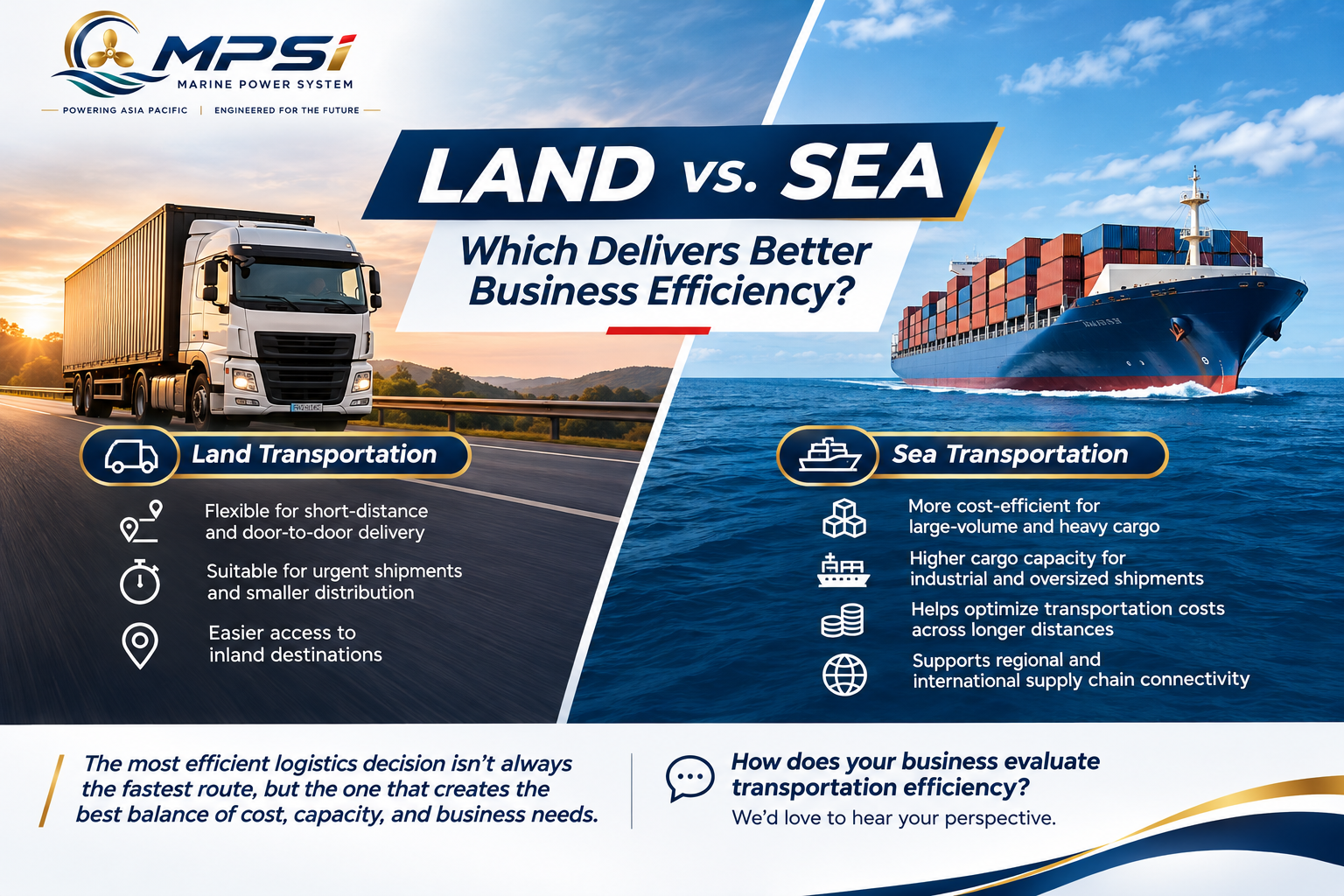
Beyond Transportation: The Business Case for Sea Logistics, Vessel Ownership & Marine Engineering Efficiency
In today's interconnected global economy, transportation is more than a logistical requirement. It is a strategic business decision that influences operational expenditure, supply chain reliability, and long-term competitiveness.
For businesses operating across manufacturing, energy, offshore, shipbuilding, and international trade, the ability to move goods, industrial equipment, and materials efficiently can make a significant difference.
While land transportation remains essential for domestic distribution and last-mile delivery, sea transportation offers unique advantages, particularly for businesses handling heavy cargo, large-volume shipments, and regional or international operations.
But there is a bigger consideration beyond choosing between land and sea:
Could investing in vessel ownership and the right marine power systems create greater long-term operational value for your business?
Let's explore the business considerations behind maritime transportation, vessel ownership, and marine engineering efficiency.
1. Land vs. Sea Transportation: Understanding the Economics
Choosing the right transportation method requires evaluating more than delivery speed. Businesses must consider cargo capacity, transportation costs, distance, infrastructure, scheduling, and the overall logistics requirements.
Land Transportation: Flexibility and Accessibility
Land transportation remains an important component of modern supply chains, particularly for short-to-medium-distance deliveries and inland distribution.
Its advantages include:
Flexible delivery routes and scheduling.
Direct access to warehouses, industrial facilities, and inland destinations.
Suitable for urgent shipments and smaller cargo volumes.
Practical for last-mile distribution and domestic logistics.
However, costs can increase depending on fuel prices, toll charges, traffic conditions, vehicle capacity, distance, and the number of trips required.
Sea Transportation: Capacity and Long-Distance Efficiency
Sea transportation provides an alternative for businesses moving large quantities of goods and industrial equipment across longer distances.
Its advantages include:
Greater cargo capacity for bulk and oversized shipments.
Potentially lower transportation costs per unit for suitable routes and cargo volumes.
Efficient transportation of heavy machinery, industrial components, and specialized equipment.
Connectivity between islands, ports, industrial hubs, and international markets.
Opportunities for cargo consolidation and more strategic logistics planning.
Although sea transportation involves additional considerations such as port handling, vessel scheduling, cargo insurance, and inland distribution, it can offer significant economic advantages when properly planned.
Comparing the Two Transportation Methods
| Business consideration | Land | Sea |
|---|---|---|
| Cargo capacity | Vehicle-dependent | Generally higher |
| Short-distance delivery | Highly practical | Less practical |
| Urgent shipments | Often more flexible | Schedule-dependent |
| Heavy industrial cargo | Subject to road and vehicle limitations | Suitable for many oversized cargo requirements |
| Long-distance bulk transportation | Can become costly | Often more economical per unit |
| Island connectivity | Depends on road and ferry networks | Strong advantage |
| Delivery flexibility | Generally higher | Depends on vessel availability and port schedules |
The most effective transportation strategy is not necessarily choosing one method over another. In many cases, combining land and sea transportation creates a more efficient and integrated supply chain.
For businesses with recurring maritime transportation requirements, however, another strategic question emerges: Should they continue relying on third-party shipping services, or consider operating their own vessels?
2. Vessel Ownership: When Does Having Your Own Vessel Make Business Sense?
For companies with consistent cargo demand, recurring transportation routes, or specialized operational requirements, owning or operating a vessel may become an attractive long-term business strategy.
Rather than depending entirely on third-party shipping providers, vessel ownership can provide greater control over transportation operations.
However, owning a vessel is a substantial investment and requires careful commercial and operational evaluation.
Potential Business Advantages of Vessel Ownership
1. Greater Operational Control
Businesses can manage vessel schedules, operational priorities, cargo requirements, and route planning according to their own needs.
This can be particularly valuable for companies with recurring shipments or specialized offshore operations.
2. Reduced Dependency on Third-Party Providers
Having access to an owned or dedicated vessel can reduce exposure to external vessel availability and charter-market fluctuations.
It can also provide greater predictability for businesses with regular transportation requirements.
3. Long-Term Cost Planning
For businesses with sufficiently high and consistent vessel utilization, ownership may provide opportunities to optimize transportation expenditure over time.
Instead of repeatedly paying third-party transportation fees, businesses can manage their own vessel operating economics.
4. Specialized Operational Requirements
Certain industries require vessels designed for specific activities, including offshore support, marine construction, towing, and specialized cargo transportation.
Having access to dedicated vessels can provide operational flexibility that general-purpose transportation services may not offer.
Own, Charter, or Outsource?
Vessel ownership is not necessarily the right solution for every business.
The decision should consider operational frequency, capital availability, cargo demand, and long-term business strategy.
| Consideration | Own a vessel | Charter a vessel | Third-party shipping |
|---|---|---|---|
| Capital investment | High | Contract-dependent | Generally lower |
| Operational control | Greater | Depends on charter arrangement | More limited |
| Flexibility | Depends on fleet availability | Depends on contract | Depends on provider |
| Maintenance responsibility | Owner-dependent | Depends on charter type | Generally provider-managed |
| Long-term utilization | Important | Contract-dependent | Less direct exposure |
| Best suited for | Consistent operational demand | Project-based or variable demand | Occasional transportation needs |
The key consideration is utilization.
A vessel that operates regularly and generates sufficient commercial value may justify its ownership and operating costs. However, an underutilized vessel can become a significant financial burden.
Businesses should evaluate the total cost of ownership, including:
Initial vessel acquisition or construction.
Financing and depreciation.
Fuel consumption and operating expenses.
Crew salaries and training.
Maintenance and spare parts.
Insurance and regulatory compliance.
Port charges, docking, and other operational costs.
Ultimately, the right decision depends on whether vessel ownership creates measurable value compared with available alternatives.
3. The Engineering Behind an Efficient Vessel
Once a business decides to invest in vessel ownership or new vessel construction, the conversation moves beyond commercial considerations and into engineering.
A vessel's operational performance is influenced by multiple technical factors, including its hull design, displacement, operating profile, propulsion configuration, and machinery selection.
This is where shipbuilders, naval architects, marine engineers, and equipment suppliers play important roles.
Why Propulsion Selection Matters
The propulsion system is one of the fundamental components of vessel performance.
Selecting the appropriate propulsion configuration requires understanding how the vessel will operate, its intended applications, environmental conditions, and performance requirements.
Important considerations include:
Propulsion Performance
The propulsion system should be selected according to vessel size, required thrust, speed, operating profile, and maneuverability requirements.
Fuel and Energy Efficiency
Machinery selection and propulsion configuration can influence fuel consumption and overall operating expenditure.
The right technical configuration should consider both initial investment and long-term operational costs.
Maneuverability and Operational Requirements
Different vessel types require different maneuverability characteristics.
For example, offshore support vessels, harbour tugs, and specialized marine vessels may have different propulsion and positioning requirements depending on their operational applications.
Maintenance and Lifecycle Considerations
Equipment reliability, maintenance accessibility, spare-parts availability, and technical support should also be considered during the equipment selection process.
The Importance of Shipbuilders and Naval Architects
Efficient vessel development requires collaboration across multiple disciplines.
Naval architects translate operational requirements into vessel designs and technical specifications.
Shipbuilders integrate structural, mechanical, electrical, and propulsion systems throughout the construction process.
Marine equipment suppliers contribute specialized machinery, propulsion technologies, and technical solutions that support vessel performance.
Early coordination between these stakeholders can help ensure that equipment selection aligns with the vessel's intended operating requirements.
Rather than treating propulsion and machinery as separate procurement decisions, they should be considered important components of the overall vessel engineering strategy.
4. Marine Power Systems: Connecting Engineering Requirements with Operational Performance
Marine power and propulsion systems are essential components of modern vessel operations.
From commercial shipping and offshore support to harbour operations and marine construction, different vessel applications require different technical configurations.
The right marine power solution should be evaluated according to the vessel's intended function, operating environment, performance expectations, and lifecycle requirements.
For example:
Commercial vessels: Require propulsion configurations aligned with cargo capacity, operating routes, and transportation efficiency.
Offshore Support Vessels (OSVs): May require specialized propulsion and maneuverability capabilities depending on their offshore support activities.
Anchor Handling Tug Supply (AHTS) vessels: Require propulsion and thrust capabilities suitable for demanding towing and anchor-handling operations.
Harbour tugs: Require propulsion configurations that support maneuverability and the thrust requirements of harbour operations.
Dynamic Positioning (DP) vessels: Require appropriately engineered propulsion, thruster, and control configurations to maintain position within specified operational requirements.
There is no universal propulsion solution for every vessel.
The objective is to identify the appropriate combination of marine machinery and propulsion technologies based on actual operational and technical requirements.
5. Why the Right Maritime Partners Matter
The maritime industry operates through a highly interconnected ecosystem.
Successful vessel development and operation depend on collaboration between shipowners, shipbuilders, naval architects, marine engineering companies, equipment suppliers, and technical service providers.
For shipowners, working with the right technical partners can help translate operational requirements into appropriate equipment specifications.
For shipbuilders, reliable equipment suppliers and engineering partners contribute to smoother project coordination and machinery integration.
For naval architects, early technical discussions can support more informed decisions regarding propulsion configuration, machinery selection, and vessel design requirements.
These relationships are particularly important when developing newbuild projects, upgrading existing fleets, or evaluating specialized marine power requirements.
A vessel is not simply a collection of individual components. It is an integrated engineering system that must work together to achieve its intended operational objectives.
6. MPSI: Supporting the Maritime Industry with Marine Power and Propulsion Solutions
At Marine Power System Indonesia (MPSI), we recognize that every maritime operation comes with different technical and operational requirements.
As part of the broader marine power system industry, MPSI focuses on connecting maritime businesses with relevant marine power, machinery, and propulsion solutions.
Our approach is built around understanding vessel applications, operational requirements, and the importance of selecting suitable equipment for each project.
We believe that effective maritime solutions begin with collaboration.
Whether the discussion involves a new vessel project, propulsion requirements, machinery selection, or exploring opportunities within the maritime industry, establishing the right technical dialogue is an important first step.
By building connections with shipowners, shipbuilders, naval architects, offshore operators, and other maritime stakeholders, MPSI aims to contribute to a stronger and more connected maritime ecosystem across Indonesia and the wider Asia-Pacific region.
Powering Asia Pacific | Engineered for the Future.
7. Looking Ahead: Building a More Efficient Maritime Future
As regional trade, offshore activities, and industrial development continue to evolve, maritime transportation will remain an important part of business connectivity.
For companies evaluating their logistics strategies, the question is no longer simply whether to transport goods by land or sea.
It is about understanding how transportation, vessel ownership, engineering decisions, and marine technology work together to create long-term business value.
From evaluating the economics of vessel ownership to selecting the right propulsion configuration, every decision contributes to the bigger picture of maritime operational efficiency.
The future of maritime business depends not only on moving goods and vessels, but also on making smarter investment decisions and building stronger industry partnerships.
Let's Connect and Exchange Perspectives
Are you a shipowner evaluating a new vessel investment? A shipbuilder working on your next newbuild project? A naval architect exploring propulsion configurations? Or an offshore operator looking for suitable marine power solutions?
We welcome conversations, industry perspectives, and opportunities to connect with professionals across the maritime ecosystem.
Let's explore how the right marine engineering solutions can support your next maritime project.
Marine Power System Indonesia (MPSI)
Powering Asia Pacific | Engineered for the Future.
Suggested discussion topics:
When does vessel ownership become more commercially viable than chartering?
How can propulsion selection influence vessel lifecycle costs?
What should shipowners consider before investing in a new vessel?
How can shipbuilders, naval architects, and marine equipment suppliers collaborate more effectively?
#MarinePowerSystemIndonesia #MaritimeIndustry #MarineEngineering #MarinePropulsion #Shipbuilding #NavalArchitecture #VesselOwnership #OffshoreIndustry #Shipowners #AsiaPacific