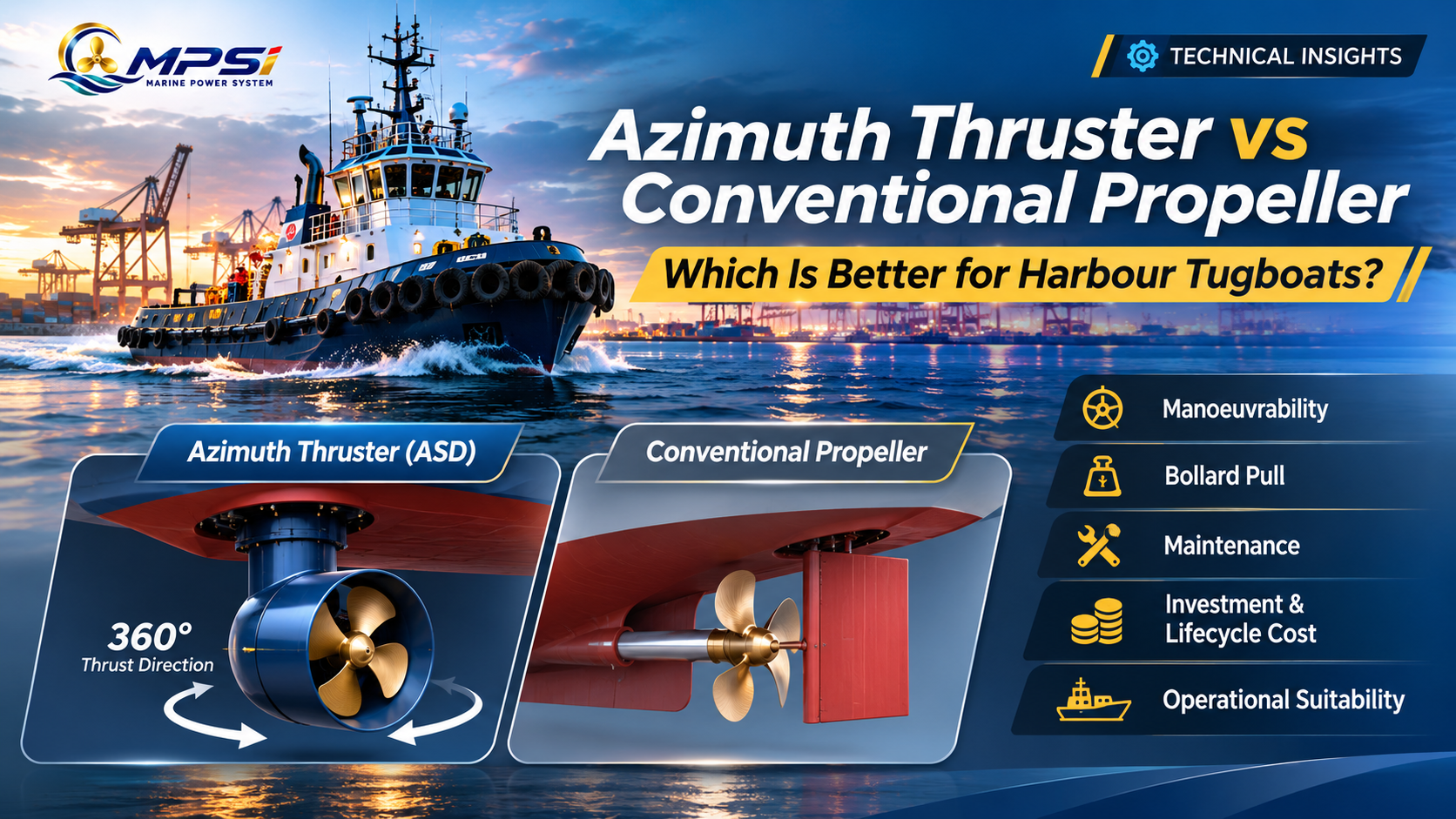
Azimuth Thruster vs Conventional Propeller: Which Is Better for Harbour Tugboats?
Introduction
Harbour tugboats play a critical role in modern port operations, assisting commercial vessels during berthing, unberthing, turning, and manoeuvring in confined waters.
For shipowners, shipyards, and naval architects, selecting the right propulsion system is one of the most important decisions during vessel design and construction.
Two common propulsion arrangements are azimuth thruster systems and conventional propeller-and-rudder systems.
Both offer distinct advantages depending on vessel requirements, operating conditions, and lifecycle costs.
1. What Is an Azimuth Thruster?
An azimuth thruster is a marine propulsion system capable of rotating its thrust direction through 360 degrees, allowing the vessel to generate propulsion force in virtually any horizontal direction.
Unlike conventional shaft-line propulsion, which typically relies on a rudder to redirect water flow, azimuth thrusters combine propulsion and steering functions.
Azimuth propulsion is commonly used in:
Azimuth Stern Drive (ASD) tugboats
Harbour and terminal tugboats
Offshore support vessels
Workboats and specialized marine vessels
Certain ferries and manoeuvring-intensive vessels
For harbour tug operations, this arrangement provides high manoeuvrability and responsive thrust control.
2. What Is a Conventional Propeller System?
A conventional propulsion system generally consists of a marine engine, reduction gearbox where required, shaft line, propeller, and rudder arrangement.
The propeller generates thrust while the rudder controls vessel direction through water flow.
Conventional propulsion remains widely used in commercial vessels, including certain tugboats, cargo vessels, fishing vessels, and workboats.
Its main advantages may include mechanical simplicity, established maintenance practices, and potentially lower initial investment, depending on vessel configuration.
However, manoeuvring performance can be more limited compared with azimuth propulsion, particularly during complex low-speed operations.
3. Azimuth Thruster vs Conventional Propeller: Key Differences
Manoeuvrability
Azimuth thrusters can redirect thrust through 360 degrees, enabling rapid changes in vessel movement and heading.
This is particularly valuable when tugboats operate near large commercial vessels, terminals, or confined harbour areas.
Conventional propeller systems typically depend on rudder effectiveness, vessel speed, and additional manoeuvring arrangements.
Bollard Pull Performance
Bollard pull is an important performance indicator for harbour tugboats, representing the pulling force a tug can generate under specified test conditions.
Both azimuth and conventional propulsion systems can be engineered for substantial bollard pull.
Actual performance depends on installed power, propeller design, nozzle configuration, propulsion efficiency, hull characteristics, and operating conditions.
Azimuth propulsion should not automatically be assumed to produce higher bollard pull solely because it offers 360-degree steering.
Operational Flexibility
Azimuth-equipped tugboats offer significant flexibility in directing thrust during vessel assistance operations.
This can be especially advantageous for ship-handling manoeuvres that require frequent changes in thrust direction.
Conventional propulsion may remain suitable for applications involving predictable operating profiles and less demanding manoeuvring requirements.
Maintenance Considerations
Conventional shaft-line propulsion benefits from established mechanical arrangements and maintenance practices.
Azimuth thrusters incorporate additional components such as steering mechanisms, gear transmissions, bearings, and sealing systems.
Maintenance requirements vary according to manufacturer design, duty cycle, installation arrangement, and operating environment.
Shipowners should evaluate maintenance accessibility, spare-parts availability, service support, and expected lifecycle costs before making a selection.
Initial Investment and Lifecycle Cost
Azimuth propulsion systems may involve higher initial equipment and installation costs than some conventional propulsion arrangements.
However, the overall economic assessment should also consider vessel productivity, operational efficiency, manoeuvring requirements, downtime, and long-term maintenance.
The lowest initial equipment cost does not necessarily represent the lowest total cost of ownership.
4. Which Propulsion System Is Better for Harbour Tugboats?
There is no universal answer.
For modern harbour tugboats requiring high manoeuvrability, responsive thrust control, and demanding ship-assistance operations, azimuth propulsion is often an attractive solution.
Conventional propulsion can remain a practical choice for certain vessel designs, operational profiles, and budget requirements.
The most appropriate selection depends on several engineering considerations:
Vessel type and operating profile
Required bollard pull
Main engine power and RPM
Hull dimensions and available installation space
Propeller and nozzle configuration
Classification society requirements
Maintenance strategy and lifecycle cost
Shipyard integration and installation requirements
A propulsion system should be selected based on the vessel's complete technical and operational requirements rather than equipment specifications alone.
5. What Information Should Shipyards Provide When Requesting an Azimuth Thruster Quotation?
To support accurate technical evaluation and equipment selection, shipyards and naval architects should prepare the following information:
Vessel type and intended operating application
Vessel principal dimensions and design draft
Required bollard pull or propulsion performance
Main engine make, model, rated power, and RPM
Preferred propulsion arrangement and number of units
Available installation space and relevant drawings
Classification society and applicable project requirements
Project location, delivery schedule, and expected commissioning requirements
Providing complete information at the RFQ stage can reduce technical clarification cycles and improve quotation accuracy.
6. How MPSI Supports Marine Propulsion Projects
Marine Power System Indonesia (MPSI) provides marine propulsion and manoeuvring solutions for shipyards, shipowners, naval architects, and marine engineering companies.
Our solutions include azimuth thrusters and other marine propulsion equipment for newbuilding and selected retrofit applications.
MPSI works with customers to review vessel requirements, coordinate technical clarification, and support propulsion equipment selection according to project specifications.
For harbour tugboat projects, early technical engagement helps align propulsion arrangements with vessel design, machinery configuration, and operational objectives.
Conclusion
Azimuth thrusters and conventional propeller systems each have important roles in marine propulsion.
For harbour tugboats operating in demanding port environments, azimuth propulsion offers significant manoeuvring flexibility. Conventional systems may remain appropriate where operational requirements and project economics favour their use.
Ultimately, successful propulsion selection requires a balanced assessment of vessel performance, technical integration, maintenance, and lifecycle cost.
Planning a harbour tugboat newbuilding or propulsion upgrade?
Contact Marine Power System Indonesia (MPSI) to discuss your vessel requirements and request a technical evaluation or quotation for suitable marine propulsion solutions.
Visit: https://mpsiasia.com
Technical note: Equipment suitability, performance, and final selection are subject to detailed engineering review and applicable classification requirements.