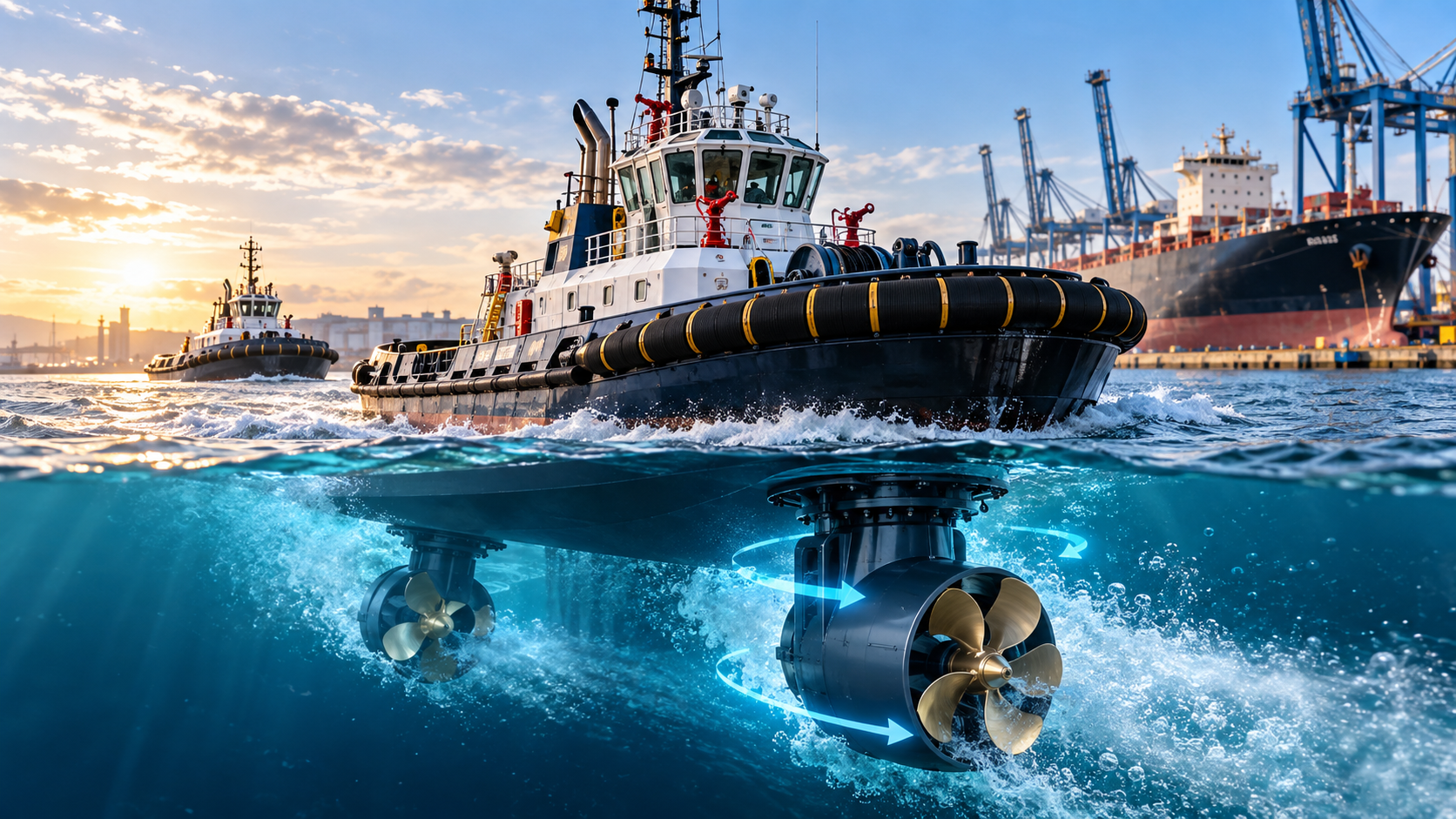
How to Select the Right Azimuth Thruster for a Tugboat
Selecting an azimuth thruster for a tugboat involves much more than matching engine power with a propulsion unit.
Tugboats operate under demanding conditions where bollard pull, manoeuvrability, reliability and rapid thrust response are critical. The right propulsion configuration should therefore be selected based on the vessel’s complete operating profile.
1. Start With the Vessel’s Operating Profile
Before selecting a thruster, it is important to understand how the tug will actually operate.
A harbour tug, terminal tug, escort tug and offshore support tug can have very different propulsion requirements.
Key considerations include operating area, expected duty cycle, towing requirements, vessel speed, manoeuvring conditions and the amount of time the vessel will operate at different load levels.
2. Required Bollard Pull
Bollard pull is one of the most important performance requirements for a tugboat.
However, achieving the required bollard pull is not simply a matter of installing more engine power.
Propeller diameter, nozzle design, gear ratio, available engine power, hull interaction and overall propulsion efficiency all influence the final performance of the vessel.
The propulsion system should therefore be evaluated as a complete package.
3. Propeller Diameter and Vessel Draft
A larger propeller can generally improve thrust efficiency, but the vessel’s draft and hull arrangement may limit the available propeller diameter.
This becomes particularly important for tugboats operating in shallow ports, rivers or restricted waterways.
The propulsion solution must balance hydrodynamic efficiency with the physical constraints of the vessel.
4. Manoeuvrability and Thrust Response
Tugboats frequently operate close to other vessels, terminals and port infrastructure.
Fast and predictable thrust response is therefore essential.
Azimuth thrusters provide 360-degree steering capability, allowing thrust to be directed rapidly without relying on a conventional rudder arrangement.
The propulsion configuration should be selected with consideration for the vessel’s expected manoeuvring requirements and operational environment.
5. Mechanical or Hybrid Propulsion?
Traditional mechanical propulsion remains widely used and can provide a robust solution for many tugboat applications.
However, hybrid and electric propulsion architectures are increasingly being considered where operating profiles include significant periods at partial load or where owners are seeking improved fuel efficiency and reduced emissions.
There is no universal solution.
The appropriate architecture depends on the vessel’s duty cycle, operational requirements, available infrastructure and lifecycle economics.
6. Reliability and After-Sales Support
For a commercial tugboat, propulsion downtime can directly affect vessel availability and operating revenue.
Equipment selection should therefore consider more than initial purchase cost.
Availability of spare parts, technical support, maintenance requirements and long-term service capability should form part of the procurement decision.
The Right Thruster Starts With the Right Questions
Selecting an azimuth thruster should not begin with:
“How many kilowatts do we need?”
It should begin with:
“How will this vessel actually operate?”
By understanding the vessel’s mission, bollard pull requirement, operating profile, draft limitations and lifecycle expectations, shipowners, designers and shipyards can develop a propulsion configuration that delivers the required performance throughout the vessel’s working life.
Marine Power System Indonesia (MPSI) supports shipyards, shipowners and vessel operators in evaluating marine propulsion solutions for newbuilding and retrofit projects across Indonesia and the wider regional market.
For technical discussions or project enquiries, please contact the MPSI team.