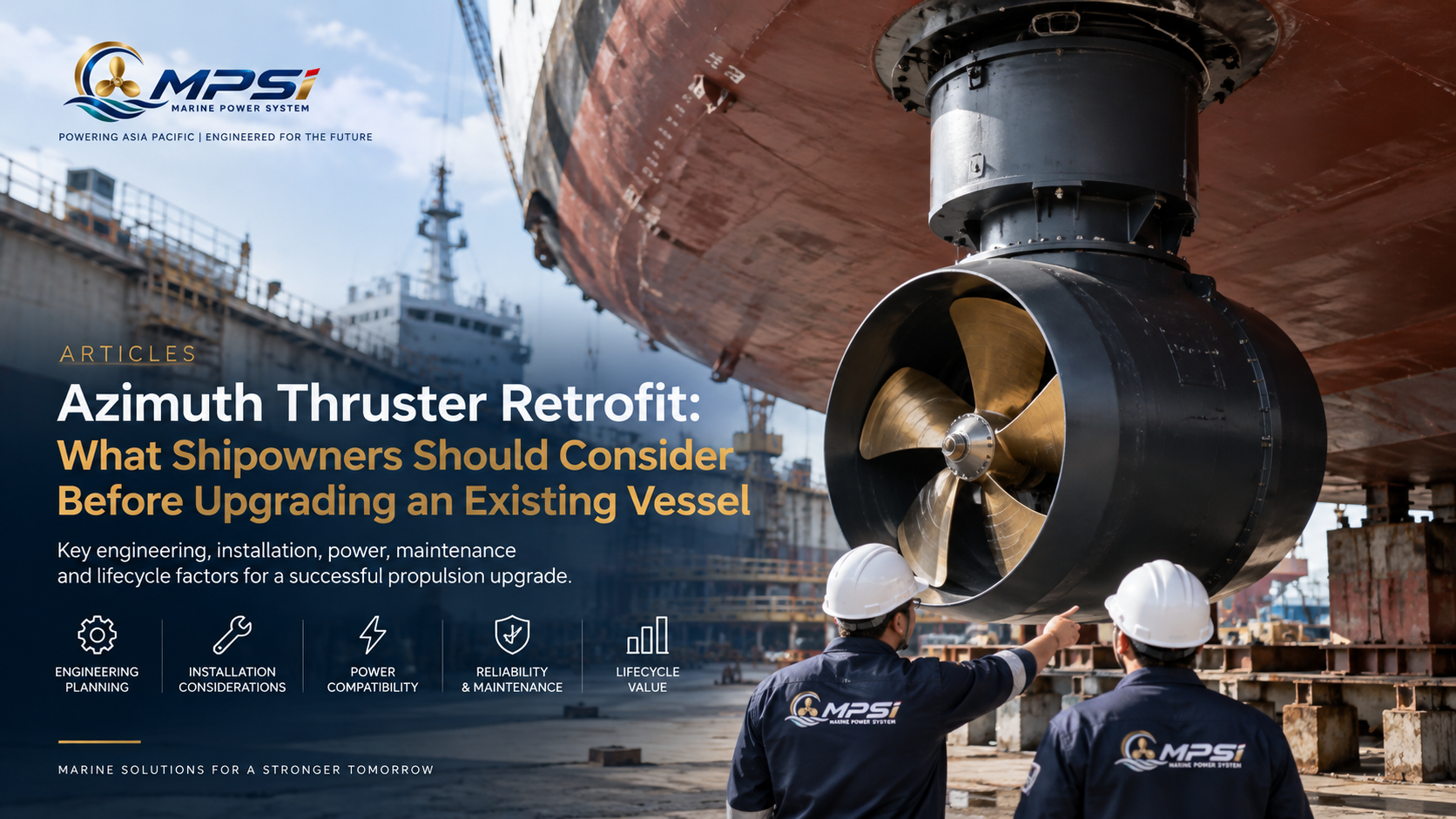
Azimuth Thruster Retrofit: What Shipowners Should Consider Before Upgrading an Existing Vessel
A vessel can remain operational for decades, but its propulsion requirements may change significantly during that time.
Operating profiles evolve. Vessel missions change. Maintenance requirements increase. Spare parts may become more difficult to obtain, while newer propulsion and control technologies become available.
At some point, shipowners may face an important question:
Should we continue maintaining the existing propulsion system — or is it time to consider a retrofit?
For some vessels, upgrading to an azimuth thruster or replacing an existing ageing thruster can improve operational flexibility and support the vessel's next stage of service life.
However, propulsion retrofit should never be approached as a simple equipment replacement.
The entire vessel needs to be considered.
1. Start With the Vessel's Current Mission
Before selecting equipment, first understand what the vessel actually needs to accomplish today.
A vessel originally designed years ago may now operate under very different conditions.
Consider:
- Has the operating area changed?
- Does the vessel require greater manoeuvrability?
- Has the vessel's operating speed or load profile changed?
- Are additional operational capabilities required?
- Is the existing propulsion system becoming expensive to maintain?
- Are spare parts becoming difficult to obtain?
A retrofit should solve an operational problem rather than simply introduce newer equipment.
The starting point should therefore be the vessel mission and operating profile.
2. Existing Hull and Structural Arrangement
Unlike a newbuild project, a retrofit needs to work within an existing vessel.
Available installation space, hull geometry, structural arrangement, draft and machinery-room configuration can all influence what propulsion solution is technically feasible.
Installing or replacing an azimuth thruster may require evaluation of:
Thruster foundation and mounting arrangement
The vessel structure must be capable of supporting propulsion loads.
Hull geometry and available draft
Propeller diameter and thruster arrangement need to match the available underwater space and operating conditions.
Installation and removal access
Future maintenance should be considered during the retrofit design, not after installation.
Depending on the scope, structural modification may therefore become an important part of the project.
3. Power Compatibility
A new thruster must be properly matched to the vessel's available power system.
Simply selecting a thruster based on the same kW rating as the existing equipment may not provide the desired result.
The evaluation should consider the complete propulsion train.
For mechanically driven systems, this may include:
Engine → gearbox → shafting → thruster → propeller
For electric or hybrid propulsion:
Generator/Battery → power management → drive → electric motor → thruster
Engine speed, torque, gearbox ratio, motor characteristics, electrical capacity and control architecture all need to be considered.
The objective is not simply to install a new thruster.
It is to ensure the complete propulsion system works correctly together.
4. Propeller and Thrust Requirements
Installed power alone does not determine vessel performance.
Propeller diameter, RPM, nozzle configuration, FPP or CPP selection, vessel resistance and operating conditions all influence the thrust that can actually be delivered.
For tugboats, bollard pull may be particularly important.
For ferries and workboats, efficiency across the normal operating profile may carry greater weight.
For offshore vessels, manoeuvrability and station-keeping requirements may become critical.
This is why retrofit engineering should consider required vessel performance, rather than simply replacing one equipment specification with another.
5. Controls and System Integration
Modern propulsion equipment increasingly depends on integrated control systems.
A retrofit may therefore need to interface with existing:
- Bridge controls
- Engine or motor controls
- Power management systems
- Alarm and monitoring systems
- Dynamic positioning systems
- Vessel automation systems
Compatibility needs to be evaluated carefully.
In some cases, retaining part of the existing control architecture may be possible.
In others, modernisation may provide better long-term support and reduce future obsolescence risk.
Lifecycle availability of control-system components is a real consideration in propulsion upgrades; Wärtsilä, for example, explicitly positions control-system upgrades around obsolescence and continued component support.
6. Installation and Dry-Dock Planning
For a working vessel, downtime matters.
The engineering solution therefore needs to consider not only what will be installed, but also how it will be installed.
Shipowners and shipyards should evaluate:
- Dry-dock availability
- Removal of existing equipment
- Structural modification
- Equipment lifting and access
- Mechanical and electrical installation
- Alignment
- Testing
- Commissioning
- Sea trials
Good preparation before the vessel enters the yard can reduce uncertainty during installation.
This is particularly important because propulsion downtime can directly affect vessel availability and commercial operations.
Lifecycle providers increasingly structure maintenance and replacement programs specifically around reducing vessel downtime; Kongsberg's Thruster Support Pool is one example of this approach.
7. Classification Requirements
Propulsion modifications may affect areas subject to classification review.
Depending on the project scope, engineering documentation may need to cover structural modifications, propulsion arrangement, electrical integration, control systems and other relevant systems.
Shipowners should therefore involve the shipyard, equipment supplier, naval architect and classification society sufficiently early.
Resolving these requirements during engineering is generally preferable to discovering them during installation.
8. Maintenance Accessibility
A retrofit should not only improve today's vessel.
It should also make sense for the next several years of operation.
Ask practical questions:
Can technicians access the equipment efficiently?
How will seals, bearings and other service components be maintained?
Can the thruster be removed efficiently during major overhaul?
Which critical spare parts should be kept locally?
How quickly can technical support reach the vessel?
Major propulsion suppliers treat maintenance, spare parts, retrofit and technical support as lifecycle considerations rather than isolated after-sales activities.
9. Evaluate Lifecycle Cost — Not Only Retrofit CAPEX
The cheapest retrofit quotation is not necessarily the lowest-cost solution over the remaining life of the vessel.
Shipowners should evaluate:
Initial equipment cost + engineering + installation + maintenance + spare parts + downtime + expected operating life.
A solution requiring slightly higher initial investment may potentially provide better value if it improves reliability, serviceability or operational performance.
The relevant question becomes:
What will this propulsion system cost — and deliver — throughout the remaining operating life of the vessel?
Retrofit or Replace the Vessel?
Not every vessel should be retrofitted.
The decision should consider vessel age, hull condition, remaining service life, expected operating requirements and the extent of modification required.
For a vessel with substantial remaining operating life, propulsion modernisation may provide a pathway to extend useful service.
For another vessel, extensive modification may not be economically justified.
This decision therefore requires both engineering and commercial evaluation.
A Successful Retrofit Starts Before Dry Dock
The most successful propulsion retrofit projects begin long before equipment arrives at the shipyard.
They begin by understanding:
The vessel.
The mission.
The existing propulsion system.
The desired performance.
The installation constraints.
And the expected remaining service life.
Only then should equipment selection begin.
Because an effective retrofit is not simply about installing a newer thruster.
It is about giving an existing vessel the right propulsion system for its next stage of operation.
MPSI Asia
Marine Power System Indonesia (MPSI) supports shipowners, shipyards, naval architects and marine engineering partners in evaluating propulsion solutions for newbuild, retrofit and vessel upgrade projects.
Our focus includes azimuth thrusters, bow thrusters, electric propulsion and integrated marine propulsion solutions, supported by engineering coordination, commissioning, spare parts and after-sales support.
Planning a propulsion retrofit or thruster replacement?
Contact MPSI with your vessel type, existing propulsion arrangement and operating requirements to begin a technical discussion.
MPSI | Marine Power System Indonesia
Powering Asia Pacific | Engineered for the Future