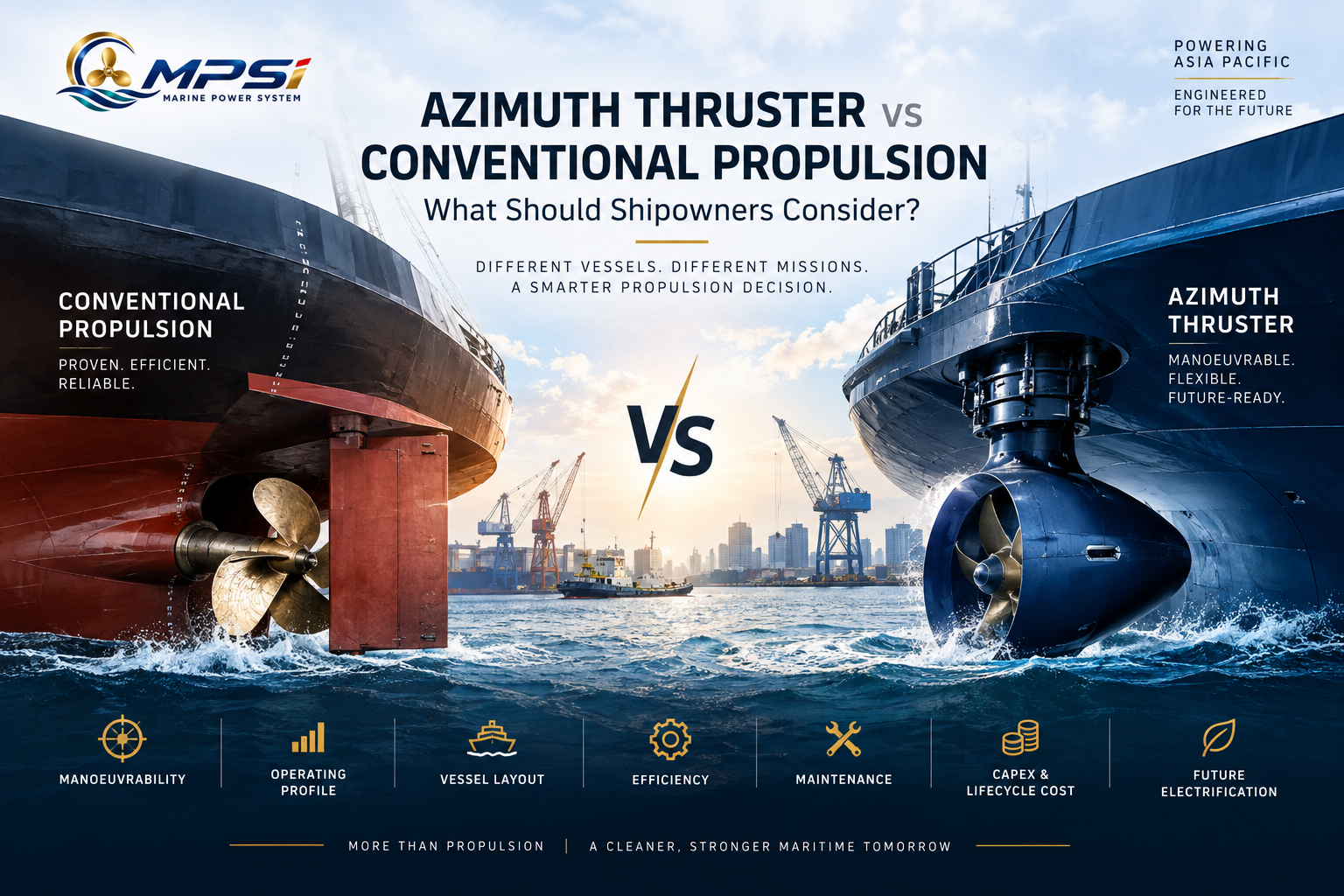
Azimuth Thruster vs Conventional Propulsion: What Should Shipowners Consider?
Choosing a propulsion system is one of the most important technical decisions in vessel design.
For shipowners, shipyards and naval architects, the discussion often comes down to two broad approaches: conventional shaft-line propulsion or an azimuth thruster-based propulsion system.
But which one is better?
There is no universal answer.
A propulsion arrangement that works effectively for a harbour tug may not be the best solution for a ferry, offshore support vessel, workboat or cargo vessel.
The right choice depends on the vessel mission, operating profile, manoeuvring requirements, machinery arrangement and lifecycle considerations.
Rather than comparing propulsion systems only by installed kilowatts, it is more useful to understand how each configuration affects the vessel as a complete system.
Understanding Conventional Propulsion
A conventional propulsion arrangement typically consists of a main engine connected through a gearbox and shaft line to a fixed-pitch or controllable-pitch propeller.
Steering is generally provided by a separate rudder system.
This architecture has been used across the maritime industry for decades and remains highly relevant for many vessel types.
Its strengths can include a relatively straightforward mechanical arrangement, extensive industry experience, established maintenance practices and good efficiency for vessels operating predominantly at steady forward speeds.
For vessels whose primary mission is efficient point-to-point transit, conventional propulsion can remain an effective solution.
However, propulsion and steering are separate functions.
For vessels requiring frequent manoeuvring, dynamic positioning or significant low-speed operation, additional equipment such as bow or stern thrusters may therefore be required.
What Is an Azimuth Thruster?
An azimuth thruster integrates propulsion and steering into a single unit.
Instead of using a fixed propeller and separate rudder, the propulsion unit can rotate around the vertical axis, directing thrust in different directions.
This provides a major operational advantage:
Thrust can be directed where it is needed.
Depending on the application, azimuth thrusters can be mechanically driven, electrically driven or incorporated into hybrid and diesel-electric propulsion architectures.
They are commonly considered for vessels where manoeuvrability and operational flexibility are particularly important, including:
- Tugboats
- Harbour craft
- Offshore support vessels
- Ferries
- Workboats
- Special-purpose vessels
But greater manoeuvrability alone does not automatically make an azimuth thruster the correct choice.
The complete operating profile still needs to be evaluated.
1. Manoeuvrability
This is perhaps the most obvious difference between the two propulsion concepts.
With conventional propulsion, thrust is primarily generated longitudinally while a rudder redirects the water flow to control vessel heading.
An azimuth thruster can instead rotate the direction of thrust itself.
For vessels frequently operating inside ports, alongside other vessels or within restricted waters, this can provide significant operational flexibility.
Tugboats are a good example.
A tug may need to rapidly change the direction of thrust while assisting another vessel. In this application, manoeuvring capability can be just as important as installed propulsion power.
The relevant question therefore isn't simply:
"How much power does the vessel have?"
It is also:
"How effectively can that power be converted into useful thrust during the vessel's actual operation?"
2. Vessel Operating Profile
Operating profile should be one of the first considerations when selecting propulsion.
Consider two vessels with similar installed power.
One spends most of its operating hours travelling at relatively constant speed between two locations.
The other spends considerable time manoeuvring, operating at low speed, changing direction and working within confined waters.
Their propulsion requirements can be very different.
This is why MPSI believes propulsion selection should begin with the vessel mission, rather than with a particular technology.
Important operating questions include:
How many hours does the vessel operate annually?
How much time is spent at cruising speed?
How frequently does the vessel manoeuvre?
Does it require high bollard pull?
Does the vessel require dynamic positioning?
How frequently does the propulsion system operate at partial load?
These answers help determine which propulsion architecture is technically and commercially appropriate.
3. Vessel Layout and Machinery Space
Propulsion selection also influences vessel design.
A conventional shaft line requires an appropriate alignment between the propulsion machinery, shafting and propeller.
Depending on the vessel, this can influence machinery-room arrangement and internal space allocation.
Azimuth propulsion can offer different machinery-layout possibilities, particularly when combined with diesel-electric or hybrid power systems.
Electrical generation can potentially be positioned differently from the propulsion units because mechanical shafting between the prime mover and propeller is no longer necessarily required.
However, greater design flexibility also introduces additional system-integration considerations.
Power generation, motors, drives, control systems, cooling systems and propulsion equipment must work together correctly.
Therefore, propulsion architecture should ideally be discussed early in the vessel design process, rather than after the vessel arrangement has already been finalised.
4. Efficiency: Look Beyond Installed kW
Comparing propulsion systems based only on installed power can be misleading.
Two propulsion systems with identical rated power may deliver different operational results.
Propeller design, hull interaction, operating speed, drivetrain losses and operating conditions all influence overall propulsion performance.
The more useful question is therefore not simply:
"How many kilowatts are installed?"
But:
"How effectively does the propulsion system convert available power into useful vessel performance?"
This becomes particularly important when evaluating vessels with highly variable operating profiles.
Propulsion efficiency should therefore be evaluated at the system level, rather than by comparing individual equipment specifications alone.
5. Maintenance and Serviceability
Maintenance is another important lifecycle consideration.
Conventional propulsion systems benefit from decades of operational experience and widespread familiarity among marine engineers and service providers.
Azimuth thrusters integrate several mechanical components into a compact propulsion and steering system and therefore require appropriate inspection and maintenance procedures.
But maintenance decisions should not be reduced to the assumption that one technology is automatically easier or cheaper.
Shipowners should evaluate factors including:
service intervals, spare-parts availability, local technical support, docking requirements, equipment accessibility and expected vessel utilisation.
For commercial vessels, downtime can sometimes be more expensive than the maintenance activity itself.
Serviceability should therefore be considered during procurement — not only after the vessel enters operation.
6. CAPEX vs Lifecycle Cost
Initial purchase price is naturally important.
But propulsion equipment can remain in service for many years.
A lower initial investment does not necessarily mean the lowest overall operating cost, while a more sophisticated propulsion system does not automatically guarantee better economics.
A proper evaluation should consider Total Cost of Ownership (TCO).
This can include:
- Initial equipment cost
- Installation and integration
- Fuel or energy consumption
- Routine maintenance
- Spare parts
- Planned overhaul
- Potential downtime
- Vessel utilisation
- Expected service life
For commercial operators, propulsion should ultimately support the economics of the vessel's entire operating life.
7. Future Electrification and Hybridisation
The propulsion decision is becoming increasingly connected with vessel energy architecture.
Traditional mechanical propulsion remains suitable for many applications.
However, shipowners are also evaluating diesel-electric, battery-assisted hybrid and fully electric vessels.
Azimuth propulsion can be integrated into several of these architectures, particularly where electrical power distribution provides flexibility between power generation and propulsion.
But electrification should not be pursued simply because the technology is available.
As discussed in our previous MPSI technical insight on hybrid marine propulsion, the starting point should remain the vessel's operating profile.
For some vessels, conventional propulsion may remain the most practical solution.
For others, diesel-electric or hybrid propulsion may provide operational advantages.
And for certain short-route or harbour applications, full electrification may become increasingly viable.
So, Which Propulsion System Should You Choose?
There is no single winner.
A simplified way of looking at the decision is:
Conventional propulsion can be highly suitable where the vessel primarily requires efficient forward transit, proven mechanical simplicity and established maintenance infrastructure.
Azimuth propulsion can be particularly attractive where manoeuvrability, directional thrust, operational flexibility and integration with electric propulsion architectures are important.
But vessel type alone should never determine the decision.
Two tugboats can have very different operating profiles.
Two ferries can operate completely different routes.
Two workboats can perform entirely different missions.
The propulsion system therefore needs to be evaluated around the specific vessel and its intended operation.
Start With the Mission, Not the Equipment
One of the most common mistakes in propulsion selection is beginning with a product specification.
A better engineering process begins with questions.
What does the vessel need to do?
Where will it operate?
What thrust and manoeuvring capability does it require?
What is its expected operating profile?
What maintenance infrastructure will be available?
How might its energy architecture evolve over its service life?
Only after these questions are understood should the propulsion configuration and equipment be selected.
Because ultimately, the best propulsion system is not necessarily the system with the highest installed power or the newest technology.
It is the propulsion system that best supports the vessel's mission throughout its operational life.
MPSI | Marine Power System Indonesia works with shipowners, shipyards, naval architects and maritime partners across Asia Pacific in evaluating marine propulsion solutions, including azimuth thrusters, electric propulsion and integrated propulsion systems.
For newbuild projects, vessel upgrades or propulsion enquiries, contact the MPSI team to discuss your vessel requirements.
Marine Power System Indonesia (MPSI)
Powering Asia Pacific | Engineered for the Future