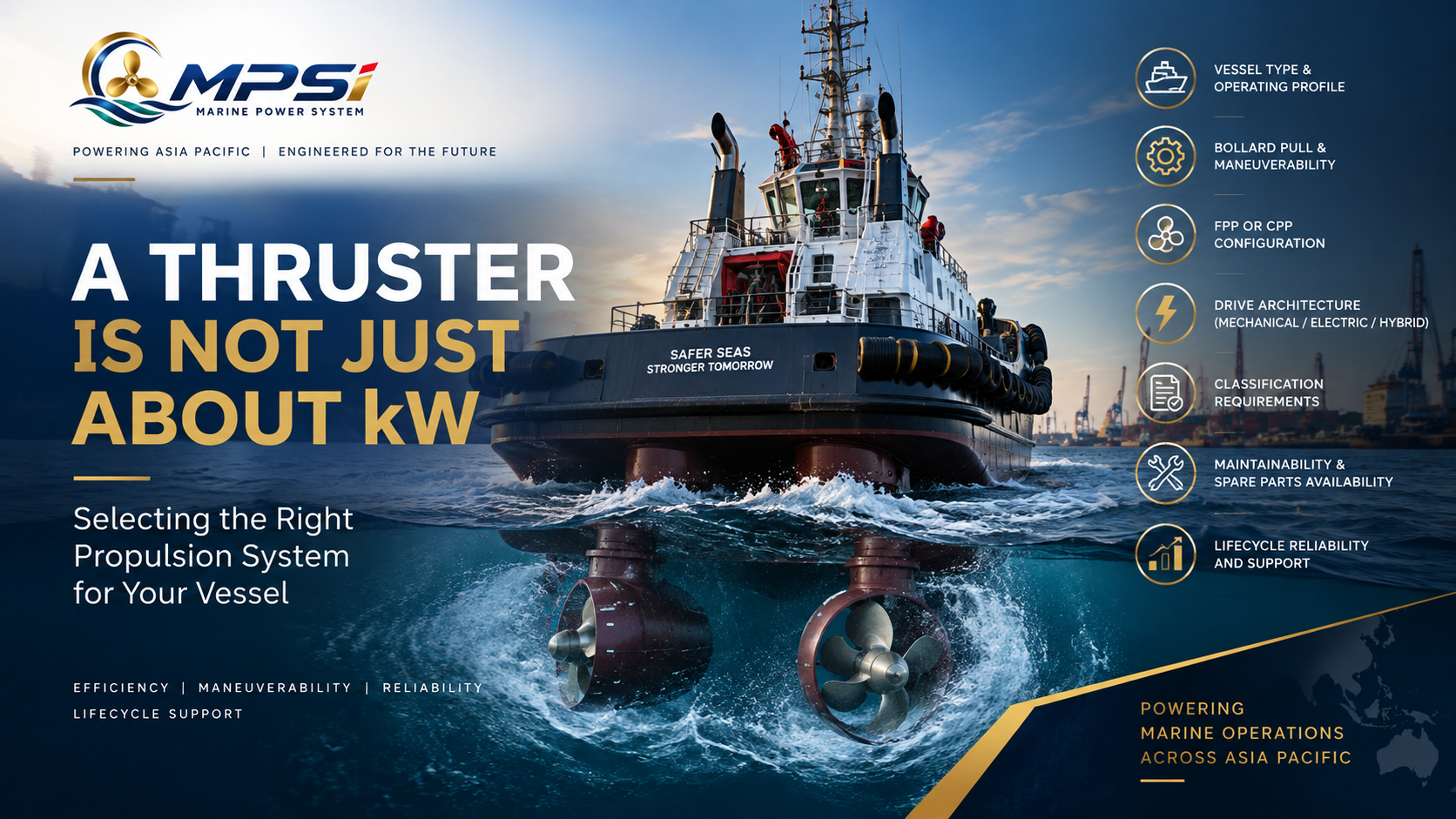
A Thruster Is Not Just About kW
When selecting an azimuth thruster or bow thruster, power rating is only the beginning.
A 1,000 kW thruster is not automatically the right solution simply because a vessel requires 1,000 kW of propulsion power. The performance of a marine propulsion system depends on how well the complete system is matched to the vessel design and its actual operating profile.
What Should Be Considered?
Proper thruster selection should consider several important factors:
• Vessel type and operating profile
• Required bollard pull, speed and maneuverability
• Propeller diameter and available draft
• Fixed Pitch Propeller (FPP) or Controllable Pitch Propeller (CPP)
• Mechanical, electric or hybrid drive configuration
• Hull and machinery arrangement
• Classification society requirements
• Maintenance accessibility and spare parts availability
• Reliability and lifecycle support
For tugboats, offshore support vessels, ferries and specialized workboats, these factors can significantly influence maneuverability, propulsion efficiency, reliability and long-term operating costs.
Think in Systems, Not Individual Equipment
A thruster should not be viewed simply as an individual piece of machinery.
The propeller, gearbox, steering system, prime mover or electric motor, control system and vessel design must work together as an integrated propulsion system.
Selecting the appropriate configuration during the early design stage can help shipowners, shipyards and naval architects achieve better system integration and avoid unnecessary compromises later in the project.
Engineering for the Actual Vessel Requirement
Different vessels have different operational priorities.
A harbor tug may prioritize bollard pull, rapid maneuvering and robustness. A ferry may place greater emphasis on efficiency, passenger comfort and operating profile. An offshore support vessel may require precise maneuverability and redundancy.
This is why propulsion selection should begin with understanding how the vessel will actually operate, rather than simply selecting equipment according to its rated power.
MPSI's Approach
At Marine Power System Indonesia (MPSI), we work with shipowners, shipyards, naval architects and marine engineering partners to evaluate propulsion requirements based on the vessel's actual application.
Our approach focuses on selecting and integrating suitable propulsion solutions while considering technical performance, reliability, maintainability and lifecycle support.
From initial system selection and engineering coordination to commissioning, spare parts and after-sales support, MPSI is committed to supporting customers throughout the lifecycle of their marine propulsion systems.
Right equipment. Right configuration. Reliable support.
Marine Power System Indonesia
Powering Asia Pacific | Engineered for the Future