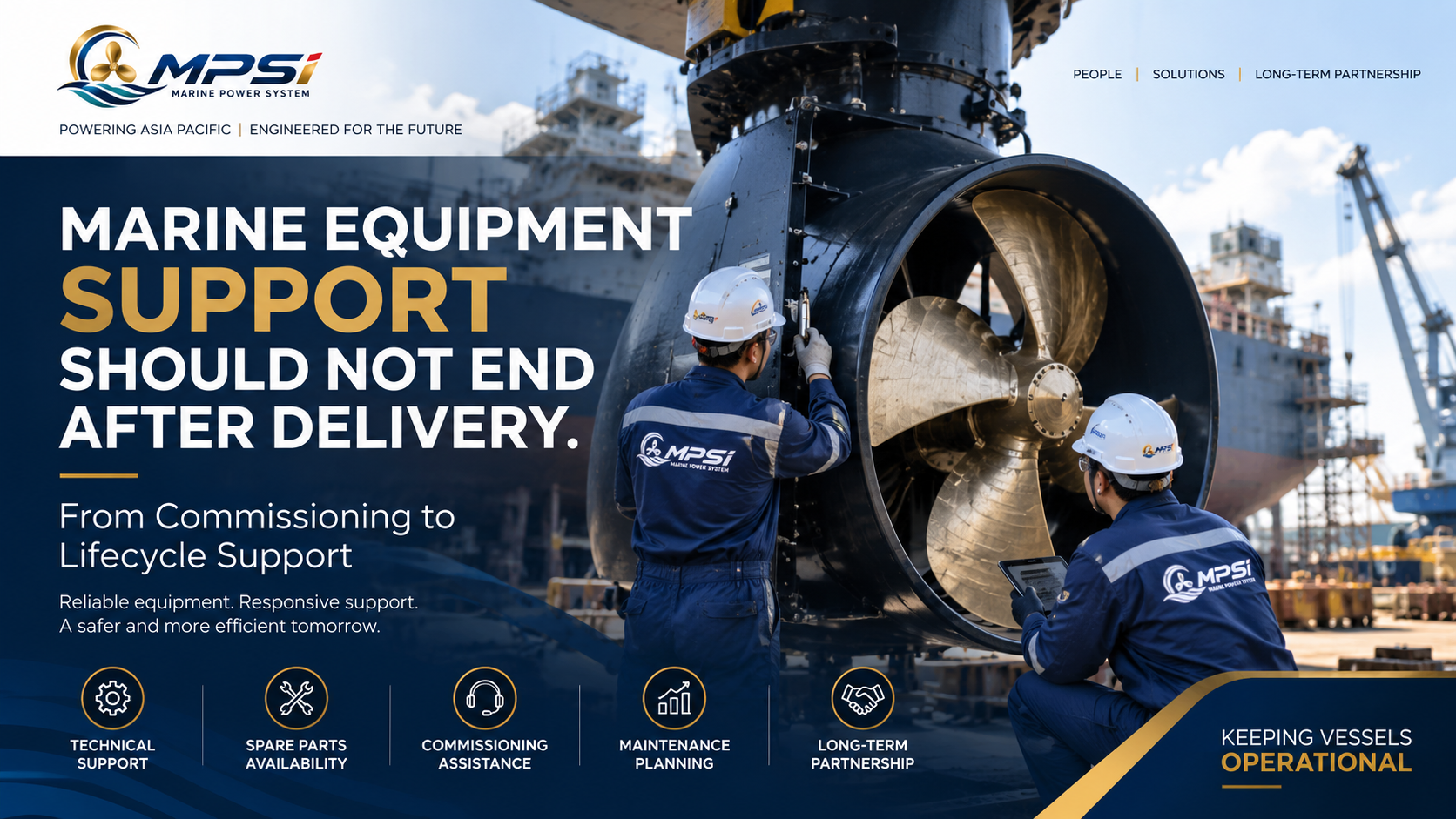
Marine Equipment Support Should Not End After Delivery
Reliable marine equipment is only one part of achieving dependable vessel operations.
Once equipment has been delivered and installed, the real operational lifecycle begins. Commissioning, spare parts availability, technical support, maintenance planning and timely troubleshooting can all have a direct impact on vessel availability, operating efficiency and long-term costs.
For shipowners and operators, the value of marine equipment should therefore be measured not only by its initial performance, but also by the quality of support available throughout its service life.
Equipment Delivery Is Only the Beginning
Marine equipment operates in demanding environments where reliability is critical.
Whether the vessel is a tugboat, ferry, offshore support vessel or specialized workboat, unexpected equipment downtime can affect vessel schedules, operational commitments and overall productivity.
This is why lifecycle support should be considered from the beginning of a project — not only after a problem occurs.
A strong support strategy should consider technical assistance, commissioning, maintenance requirements, spare parts planning and access to engineering expertise throughout the equipment lifecycle.
Commissioning Matters
Proper commissioning is an important bridge between installation and reliable operation.
Equipment needs to be correctly installed, aligned, configured, tested and integrated with the vessel's other systems before entering service.
For propulsion equipment, this may involve coordination between the thruster, prime mover or electric motor, control system, electrical system and vessel automation.
Effective commissioning helps identify potential issues early and ensures that the complete system operates according to its intended design.
Spare Parts Availability Reduces Operational Risk
A technically reliable system can still experience unnecessary downtime if critical spare parts are not available when required.
Identifying recommended and critical spare parts during the project stage allows shipowners and operators to plan maintenance more effectively and reduce exposure to unexpected lead times.
Good spare parts planning should consider equipment criticality, expected service intervals, component lead times and the vessel's operating location.
For vessels operating across Southeast Asia and other remote locations, this can become particularly important.
Maintenance Should Be Considered from the Design Stage
Maintainability should not be treated as an afterthought.
Equipment arrangement, accessibility, removal space and service requirements should be considered during vessel design and system integration.
A technically suitable propulsion system that is difficult to inspect or maintain may create unnecessary challenges later in the vessel's lifecycle.
Early coordination between shipowners, shipyards, naval architects, equipment suppliers and engineering partners can help ensure that both performance and maintainability are considered before construction is completed.
Responsive Technical Support Makes a Difference
When operational issues occur, response time matters.
Access to technical documentation, troubleshooting assistance and experienced engineering support can help vessel operators identify problems more efficiently and determine the appropriate corrective action.
For critical marine systems, effective after-sales support is therefore not simply an additional service — it is part of maintaining vessel reliability.
MPSI's Approach to Lifecycle Support
At Marine Power System Indonesia (MPSI), we believe our responsibility should extend beyond equipment delivery.
We work with shipowners, shipyards, naval architects and marine engineering partners from initial equipment selection and engineering coordination through commissioning, spare parts planning and after-sales support.
Our objective is to develop long-term relationships by providing practical engineering support throughout the operational lifecycle of the equipment we supply.
As MPSI continues expanding its support network across Asia Pacific, our focus remains on technical responsiveness, reliable equipment and long-term customer support.
Reliable equipment is important. Reliable support keeps it working.
Marine Power System Indonesia
Powering Asia Pacific | Engineered for the Future.